Showing posts with label horror movie. Show all posts

Wednesday, February 17, 2016

"Goodnight Mommy" by Olga Neuwirth


The Austrian horror film "Goodnight Mommy" is disturbing, slow, moody, and beautifully shot and Olga Neuwirth's dense, atmospheric score underscores the unsettling feeling throughout it. 

The score is used very sparingly at first, it comes into more abundant play during the latter half of the film, which makes sense since "Goodnight Mommy" is basically a one hour 40 minute crescendo. Reverb-soaked atmospheres adorn the picture in outdoor environments, adding to the vast feeling of the cornfields and forests that surround the house that most of the film is set in. Inside the house we're confined, claustrophobic - strange, out of focus photographs are on the walls. Though the house is large it feels cramped; and when we're inside it the music reflects the cramped feeling. The score is almost exclusively atmosphere; melodies don't really appear out of the haze.

There's a lot of effective sound design outside of Neuwirth's excellent score - the tried and true "not quite in tune distant piano played by a child" is used well here, as well as children singing a lullaby in unison. The kind of stuff that seems to work every time. What sounds like it may be a glass armonica plays a baroque piece in one scene; I didn't recognize it, it may be Neuwirth's own or it could just as easily be from the actual baroque era. (A glass armonica is an instrument that produces a sound similar to running your finger over the edge of a wine glass; obviously the mechanics of it are more sophisticated than that. It could also just be a church organ on the flute setting.)

For more on Severin Fiala and Veronika Franz great horror film, read this great AV Club piece on it. Or better yet just watch the movie with no expectations. It's streaming on Amazon Prime now.

Wednesday, December 9, 2015

"It Follows" by Rich Vreeland


David Robert Mitchell's "It Follows" is like candy for the eyes and brain, and Rich Vreeland's excellent score is the ear candy that adorns it. It's heavy with distorted synthesizers, ominous low tones, ring modulated bells, swooping filtered sound sculptures, and even some John Carpenter-esque moments. It often refers to 70's and 80's horror music but always sounds fresh and cutting edge. There's a few scenes in which all the sound drops out and we're left with only the music, which has a great, classic effect.

It doesn't hurt that these sounds complement one of the freshest horror films in recent memory. It's great filmmaking. Nice wide camera angles. There's allusions to classic horror but like the music, the film feels modern, or even ahead of its time. Mitchell shows the urban decay of Detroit to great effect which adds to the unease. And what is the time setting? It's hard to know, which adds a fascinating aspect to the film. The teens that make up the core cast watch old TV's that look to be from the 70's or 80's, they drive cars from the 70's and yet one reads a book on what looks like a modern e-reader in the shape of a shell. I'd watch the film again just to try to find more clues of the time setting, and that's only one of the things that makes "It Follows" so enjoyable and absorbing. It was made on a very low budget, but you'd never know it. There's very little special effects or gore but it's very unsettling. Both Mitchell and Vreeland (also known as Disasterpiece) are going places. See it now or risk living a life filled with sorrow and regret.

Thursday, November 5, 2015

"A Girl Walks Home At Night" by Johnny Jewel


What a great vampire flick. There's a lot of classic stuff going on here. The film is in black and white, and a lot of the aesthetic here is an homage to French and Italian new wave, not a style often referred to in modern horror films. The music, by Johnny Jewel of the great Portland synth-pop duo the Chromatics (along with various others), manages to be very cutting edge but also to work within that new wave aesthetic. Even the techno that a coke-snorting, slimy drug dealer listens to is top notch. Lots of incongruous elements are fitted together nicely; an operatic female voice sings over a ragtime piano in an atmosphere of strings; a deep, vintage-y guitar slowly tremolos under a male voice singing in (presumably) Farsi; we also have the more standard fare of low percussion decaying endlessly and soaked in reverb while dissonant high strings freak us out. There's definitely some sonic references to David Lynch's "Eraserhead" in the sound design (or any Lynch film afterward and through Mulholland Drive); infinite drones that perfectly complement the dark, empty streets of the film's setting of Bad City. Much of the soundtrack is Iranian pop, which works well, and also the Portland band Federale, which lends a spaghetti western-ish aspect to the mix. It's an extremely varied soundtrack that somehow manages to work within the world it underscores.

You can currently stream "A Girl Walks Home At Night" on Netflix. Or if you can manage to see it in the theater, I'd imagine that would be worth it.


Monday, October 26, 2015

"Beyond the Black Rainbow" by Jeremy Schmidt


This is just how I like it. Analog synths, mellotron choirs, surreal atmospheres, and jarring dissonant stabs work together to create the perfect mood for the score of Panos Cosmatos' midnight movie "Beyond the Black Rainbow". It's almost as if Jeremy Schmidt's excellent music was created specifically for me. That's what a good composer can make any listener think when they're experiencing his or her music - make them think it's just for them. Another thing a good composer does is heighten the experience of the film itself, because after all the ear informs the eye.  A movie with a great score is a much better movie, and that's the case here with "Beyond The Black Rainbow".

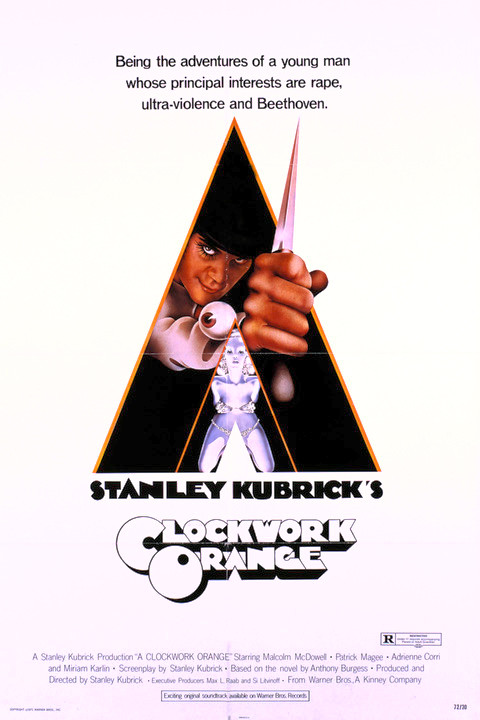
The film itself is a great sci-fi/horror/midnight movie. The color, the aesthetic, the atmosphere is perfect; it also looks like it was shot on real film. It reminds me a bit of the surreal world contained in the house of the final episode of David Lynch's "Twin Peaks", and a bit more obviously of Stanley Kubrick's "2001" and parts of "A Clockwork Orange" (Note the similarity between the poster above and the poster for the latter). Due to the surreal nature of the film, it's quite slow, so don't expect fireworks, (a lot of slowly tracking down hallways while Schmidt's score freaks us out) and don't expect a whole lot to happen, but there's a story there; a story that reminded me of George Lucas' thesis film "THX-1138" (if you haven't seen that definitely do it as soon as you can or risk living a life of regret). And also see "Beyond the Black Rainbow" - at the time of this writing is freely available to stream through Netflix.

Monday, September 28, 2015

"The House of the Devil" by Jeff Grace and Graham Reznick


If someone played Ti West's "The House of the Devil" for me and told me it had come out in 1980, I don't think I'd have any reason not to believe them. If I had been watching carefully I might have noticed that it probably looks a little cleaner - it was presumably shot digitally ** - and instead of film grain, they use noise (which is just like tiny semi-transparent dots that randomly pop in and out for a millisecond, sort of like an old TV that isn't getting a signal at full strength.) The titles, the music, the sound design, are all authentically late 70's, early 80's.

Jeff Grace's score and Graham Reznick's sound design are impressively authentic, and beyond that, very satisfying, putting us in the creaky old Victorian house in the middle of nowhere where the majority of the film takes place. Atonal strings bend in and out of pitch, the obligatory old piano plays an unsettling tune, monastic drones a la "Hellraiser" add to the ritualistic atmosphere, and low drums add sporadic punctuation to the more intense scenes. Great work.

A few notes, some of these you might consider spoilers depending on how picky you are. 

- It takes a very long time for anything to happen. There's about 30 minutes left in the runtime of 95 minutes before there's anything that could be considered scary going on. When something does happen, it's not particularly scary, but one could argue this stylistically appropriate: when we go back and revisit classic horror from the 70's and 80's, the era this film is emulating, those movies are not that scary by todays standards. West seems to have set out to make a film using only the technology that was available during the era it stylistically emulates. The makeup is pretty archaic looking; there's no noticeable CGI, etc. If you dig horror movies from the 70's and 80's for the style and the great scores and nostalgia of it, as I do, you'll love this. It must have been really fun to make. However, if you watch a horror movie with the express purpose of getting scared, "The House Of The Devil" is not for you. 

- A couple more nit-picky things; in once scene Jocelin Donahue, who plays the main character Samantha, is ascending a stairwell toward an offscreen muffled noise when suddenly the doorbell rings very loudly, making us jump; however the doorbell is nowhere near the shot (at least as far as I could tell). 

- One of the songs Samantha listens to while she dances around the house is "One Thing Leads To Another" by the Fixx, which came out in 1983 - this film looks to be stylistically emulating an era at least a couple years before that, even though otherwise the song is a great choice for the scene, from a nearly forgotten and underrated band.

Apropos of nothing, I have a new project which is duo called Jake and Elizabeth, you can buy/listen to our first EP here: jake-and-elizabeth.com

** Graham Reznick tweeted and let me know the film was actually shot on 16mm film, so there goes my theory!


Monday, May 11, 2015

"The Case of the Bloody Iris" by Bruno Nicolai


Bruno Nicolai's score to Giuliano Carnimeo's 1972 giallo thriller "The Case of the Bloody Iris" is as fun as the film itself. It begins with a theme that contains all the hallmarks of the Italian film scores of the day: heavy, groovy bass and drums, overlaid with a melody played by a harpsichord, with some high strings joining in as things progress.  There's plenty of the classic elements of horror scores as well: dissonant high pitched strings with piano playing tense low notes, and in one of the more original moments, atonal mandolin music. Nicolai is a master composer and film scorer but nothing here is particularly groundbreaking. I like the toughness to the sound of this score. A lot of film scoring of the giallo era has that toughness because of the technology in 1972, just before recording techniques employed a more sanitized approach.

The film stars the knockout Edwige Fenech as an oft-naked young woman who moves into an apartment with another oft-naked young woman immediately after the former occupant (also an oft-naked young woman) is brutally murdered. Don't expect anything to start to make more sense from there on in; the plot is thin, and the solution to the mystery is thoroughly unsatisfying, but none of that matters because we're not watching it for the plot, we're watching it for boobs and gore (in this case thankfully more of the former). "The Case of the Bloody Iris" is completely overdubbed, and like most of the other giallo horror films of the day, that only adds to the unintentional humor; the dialogue is hilarious: "she's black, but not too black"; "we're all human and every man wants a black girl". It also contains probably the best reaction/non-reaction from a character that's being clung to by a girl who's just been stabbed and is covered in blood.

I'd love to see a sub-titled version of some of these movies, even though I wonder whether it would be worth it. It could be that the performances come off a lot more powerfully and that adds to the impact of the film. Or it could be that it's better over-dubbed because that makes it all the more bad-good.

This is a solid giallo film but I would recommend the somewhat similar "Baba Yaga" over this one.

Monday, May 4, 2015

"Baba Yaga" By Piero Umillani


Piero Umillani's diverse score to Corrado Farina's giallo horror film "Baba Yaga" sounds like at times like a soundtrack to a great American blaxploitation film, and at others some classic 70's horror films like "the Omen" or "Carrie".

This era of giallo filmmaking features a glut of Italian composers who are naturally gifted at making scores that mix up genres; they're very diverse but the skillfulness in the execution is always impressive. Not only does Umillani jump all over the map stylistically here, but he puts a lot of fresh touches on his music, so that nothing sounds by-the-numbers: the sexy opening titles feature a organ quartet laying down a tough, funky groove. A gritty blues rock song seamlessly transitions into jazz fusion. A celesta chimes a pretty melody, the harmony is provided by a clavinet that sounds like a classical guitar; this theme is later reprised with a mellotron flute in place of the celesta. A lounge jazz piano is accompanied by a cathedral organ. In one scene, an almost Mancini-esque vibraphone adds to the mystery.

This film appears to have been filmed with the actors speaking their native languages and then was overdubbed depending on the country of release; for example Carroll Baker speaks English and many of her co-stars speak Italian and are overdubbed for the English version. As a result, the dialogue can be truly bizarre and almost non-sensical, often resulting in the unintentional hilarity that makes these films so fun to watch. It could be that some of the metaphors get lost in translation from Italian to English. But let me be clear, this is an amazing film from beginning to end.

There are also plenty of tits.

And there's a virtual shitload of amazing cinematic ideas. The filmmaking seems more influenced by French new wave than more typical Italian giallo; there's loads of great images and the quick cutting you'd expect from Goddard (who is discussed at a party of intellectuals at the start of the film. "Goddard is Goddard". So true. It would be really weird if Goddard was Jean Stapleton). It's colorful and vibrant: occasionally reinforcing its vibrance is still black and white photography intercut with live action, the same motif is then used with close-ups of the pages of a graphic novel in place of the photos.

I can't recall having seen another film which features such well shot sex in one scene, and Jesus getting punched in the face in another. In fact I don't think I've ever seen a film with only the latter. If anyone can think of any great Jesus-getting-punched-in-the-face scenes from other films, let me know. The music is great, the film is great, see it immediately or risk living a life of regret.


Monday, April 27, 2015

"Tenebre" by Massimo Morante, Fabio Pignatelli, and Claudio Simonetti


The score for Dario Argento's giallo masterpiece "Tenebre" is so ahead of its time that I'm sure I could fool an unwitting friend into believing it came out yesterday. The main theme was used as a sample by the Parisian electronic duo Justice for the song "Phantom" on their well regarded 2007 album "Cross"; it features an epic evil robot sounding vocoder line and driving disco drum beat. Justice did not have to do much to it to make it sound new. In my opinion they definitely did it justice!! WAKA WAKA! Get out of here, Dad.

Throughout the film there's disparate styles coming together to create an effective score: heavy breakbeats with weird choirs and vocals by synthetic operatic demon women, syncopated bass lines, amazing Giorgio Moroder-esque disco (which plays under the credits, cutting out abruptly for a few seconds and then hilariously continuing right where it's left off in the next scene), and plenty of that weird funk sound that only Italians making music for giallo horror films seem to be able to create. Warbly, unsettling jack-in-the-box music and even baroque organ, neither of which sound on paper like something that would fit the general tone the composers have set fit in perfectly.

The three composers were ex-members of the legendary Italian band the Goblins, who scored many horror films in the 70's and 80's (including the well known "Suspiria", another giallo masterpiece of Argento's), and their mastery of making music for the genre is on full display.

I love Tenebre - not only is it a great film but there's plenty of WTF moments, particularly in the dialogue overdubbing; I spent almost the entire film trying to figure out if the cast was filmed speaking Italian and was later overdubbed in English, eventually coming to the conclusion that no, they're speaking English the whole time and occasionally (or really, more than occasionally) the audio doesn't seem to be synced up correctly, though I'm still not sure about it (do you know?). In one of the countless unintentionally hilarious moments two of the main characters try to sneak around behind the house of the suspected killer while wearing brightly colored clothes and whispering and talking to each other audibly to anyone within 50 yards. "He couldn't have seen us!" says one, as the suspected killer looks out his window. Watch this movie, listen to the soundtrack - (be warned that the link to the film is going to a streaming Amazon version which is really shitty quality; however it doesn't seem to be possible to stream a higher quality version (anyone out there know of one?) and to buy it on blu-ray or DVD seems a pretty expensive proposition but it's probably worth it. Cin cin!